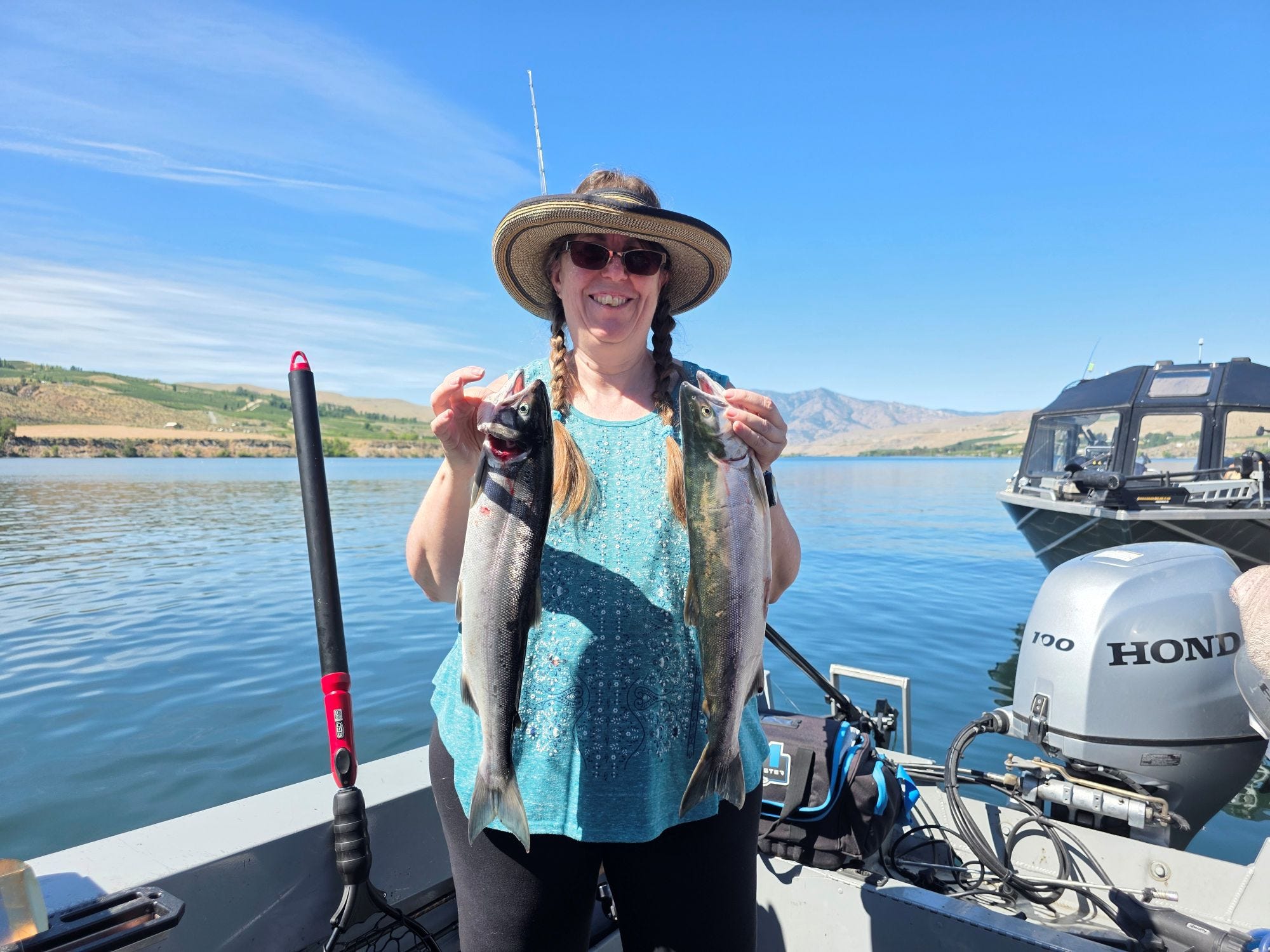
Hooked: A First-Timer’s Dive Into the Sockeye Circus
I thought I was signing up for a relaxing day on the water. I was wrong.

It started when I got invited on an all-girls fishing trip for sockeye salmon. Yum. I love salmon. I’d been fishing before, mostly with my grandparents as a kid. My brother and I used to catch tiny bluegills in the local pond and toss them back. (My grandma considered them family. Eating one would’ve been like roasting the neighbor’s cat.) So yeah, I figured this would be fun. Low stress. Some laughs, some sunshine, and maybe a cooler full of fillets.
Then I found out I didn’t have to clean the fish, our guide would do that and even bag them up for us at the end. Jackpot! This was getting better by the minute.
Still clinging to my optimism, I called our guide to confirm the plan.
“Josh,” I asked, “what time do we need to be at the dock? Like 6? 7?”
He laughed. “If you show up at 6, you’ll be watching us from the parking lot. Be at the dock by 4:00 a.m. The fish bite early.”
I stared at my phone like it had betrayed me. My alarm usually goes off at 5:30 a.m., and even that feels like a crime. A little math told me I’d have to get up at 2:30 a.m. That’s not morning. That’s a dare.
Fine. I could do this. With coffee. Probably.
We found the dock in the pitch-black stillness of predawn. I stepped onto the boat, looked around and asked what I thought was a very reasonable question:
“Josh, is there a potty on board?”
Another laugh. “Nope.”
Suddenly, all my plans for a highly caffeinated morning dissolved. If I wanted to avoid being the one who made us go back early, hydration would have to be carefully rationed. Coffee was out. Water: limited.
Josh tried to be reassuring. “If you really have to go, I can bring the boat back and then head out again.”
Absolutely not. No way was I going to be that person.
“I’ll be fine,” I said. A bold and entirely unsubstantiated claim.
We headed out toward the fishing grounds, and Josh pointed to a horizon glittering with lights. “Welcome to the floating city,” he said.
At first glance, it looked like a lakeside town waking up. But no, it was nearly a hundred boats, tightly packed, rods bristling in every direction, each one trying to claim a patch of water in the Brewster Pool at the confluence of the Columbia and Okanogan Rivers.
“Do we drop anchor and fish?”
“Oh no,” Josh said. “Not here.”
I must’ve looked confused, so he added, “Anchoring’s not illegal, but with this many boats packed into a small area, it’s pretty much frowned upon. Makes it hard to maneuver without someone’s anchor line getting in the way.”
Trolling it was.
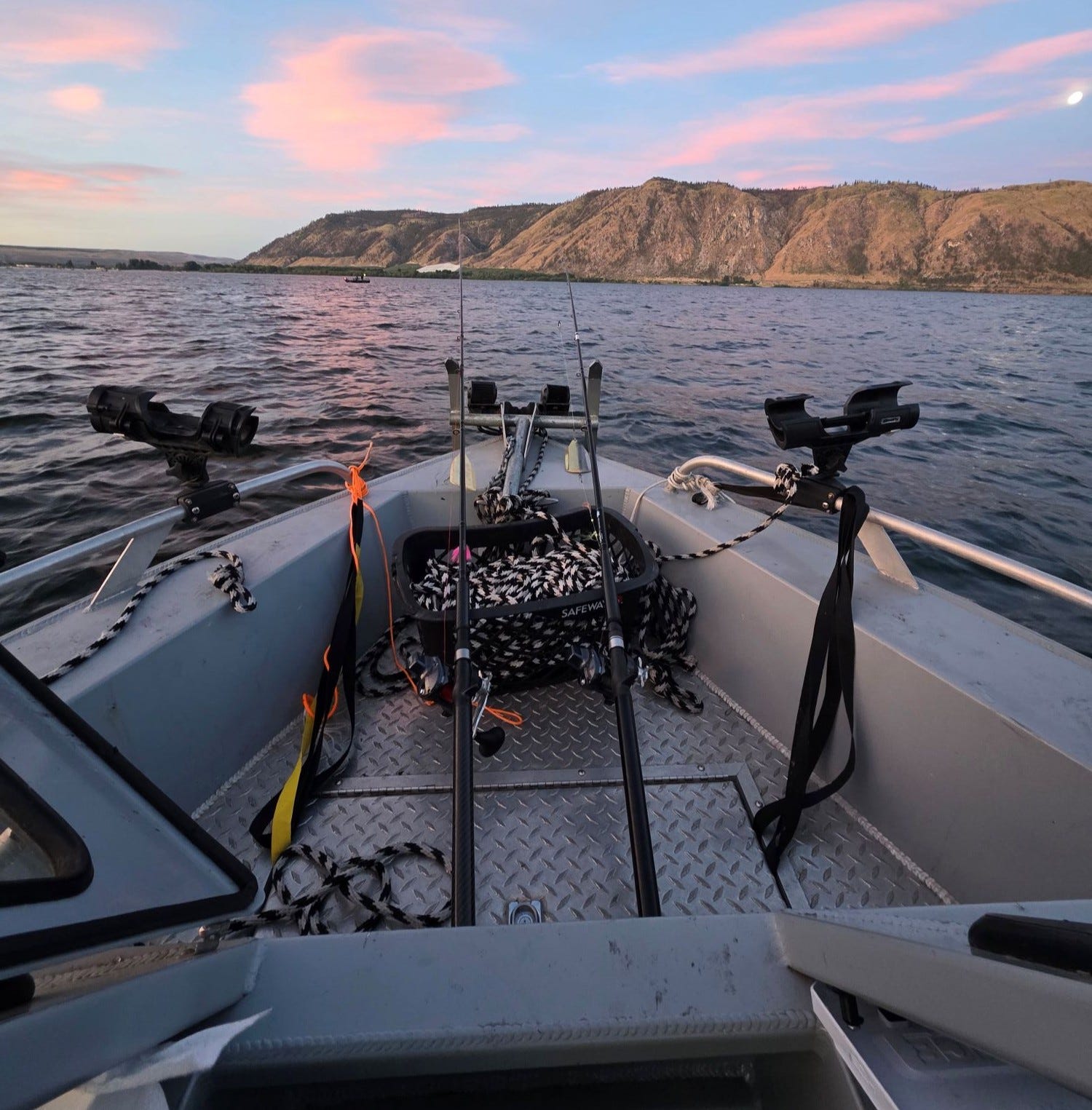
Trolling, as it turns out, involves lowering multiple lines (usually six or more), all decked out with colorful jigs, flashy plates, and extra-fragrant shrimp bait, then slowly moving the boat so the shiny stuff and stinky bait create motion that attracts the fish.
Now imagine a hundred boats all doing that. At once. Some were guide boats like ours. Some were small family skiffs. I even saw a couple of kayak anglers—what I can only assume were either very brave or very confused people. And everyone was moving. Constantly. In no discernible pattern. With lines sticking out like porcupines.
“Josh, this is chaos. How do you not run into each other?”
He shrugged. “It happens.”
A boat cruised by close enough that we could’ve shared snacks.
“And how do the lines not get tangled?”
He smiled. “The day’s not over yet.”
I tried to find logic in the madness. It reminded me of high school cruising, up one side of town and down the other, chatting from car windows. At least on Main Street you had lanes. Here, boats were cutting across each other, stopping randomly (no brake lights on boats, in case you’re wondering), and basically playing a game of high-stakes bumper cars with fishing lines. Then Josh shouted, “Fish on!”
Three pairs of eyes widened in panic. The ten minutes of “Fishing 101” we’d received at 4:00 a.m. evaporated like fog. My only internal monologue was: Don’t let go of the rod. Don’t let go of the rod.
Luckily, Josh was both patient and talented. He coached us through the chaos, talking us into our first catch like a fish-whisperer-slash-therapist. One salmon down, several to go.
Between strikes, we were introduced to what I now call Fish TV. (Josh calls it livescope, but let’s be honest… Fish TV is what it really is.).
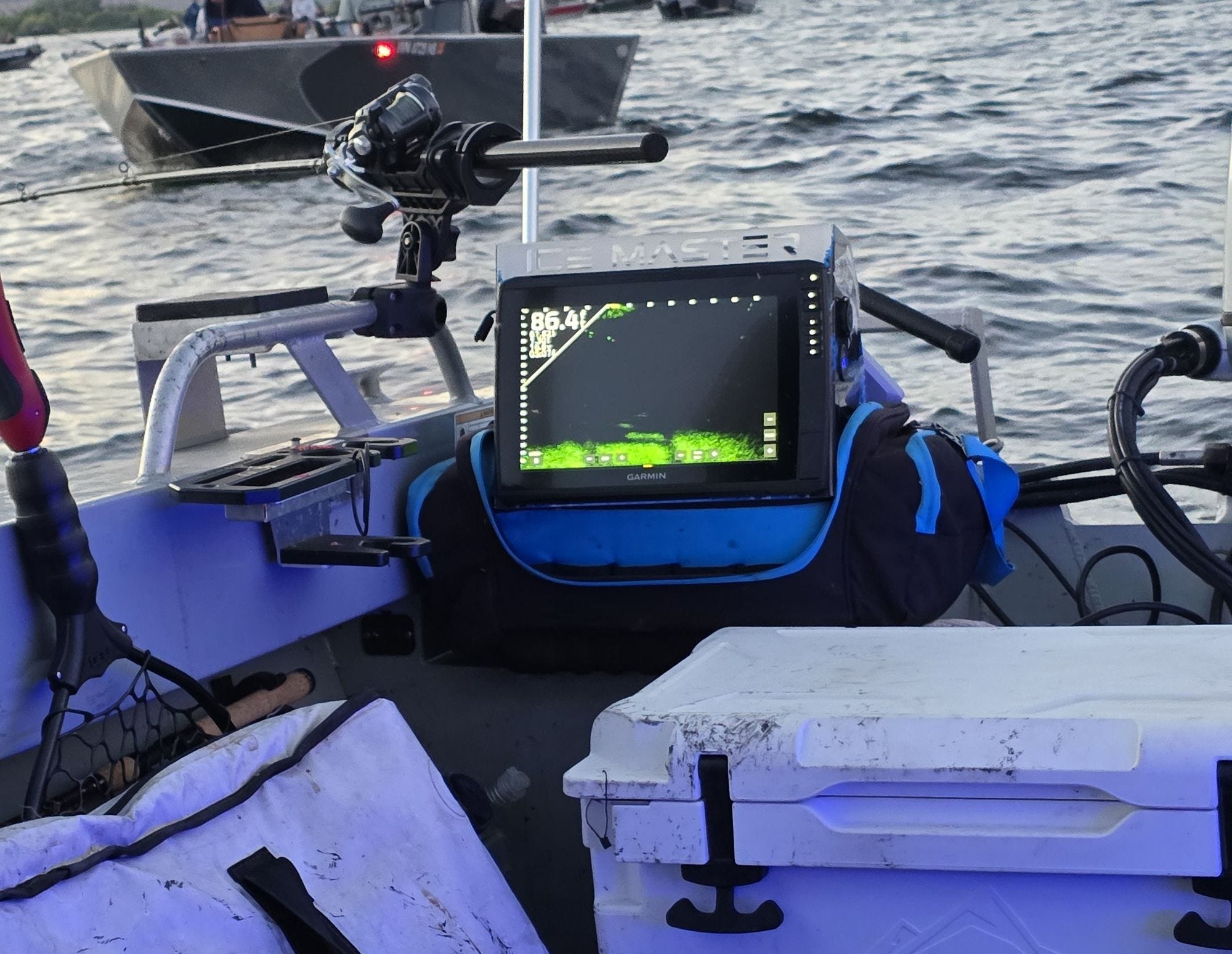
It’s a screen mounted on the boat that shows real-time underwater activity—lines, bait, fish. Little yellow blips appear as the fish move through. Bigger blip? Bigger fish. We were instantly glued to it. “Look at all those fish!” someone shouted. It was better than Netflix.
“Josh,” I asked, “why is everyone packed into this exact spot? Why not spread out?”
“This is where the sockeye gathers before heading up the Okanogan River,” he explained. “The water here is cooler and more oxygenated than what they’re heading into, so they pause and stage here. If you're going to catch them, this is your window.”
Sockeye salmon are born in freshwater streams like the Okanogan, migrate to the ocean to mature, and then return, sometimes hundreds of miles upstream, to spawn and die. Their journey is timed and tuned to specific environmental cues. When water conditions or ocean survival rates are off, the entire run can be affected.
Translation: It’s fish central. But only for a little while.
And that’s what happened this year. The 2025 sockeye return was significantly below average. In response, the Washington Department of Fish and Wildlife reduced the daily limit from four to two and closed fishing from Sunday to Tuesday to help more fish reach the spawning grounds. These restrictions hit local guides and fishing-dependent families hard. For some full-time guides, the reduction could mean losing up to a third of their seasonal income. But at the same time, conserving the fishery now helps ensure there’s still a fishery next year for everyone.
“Fish on!” someone yelled again.
This time it was me. Sort of.
The rod bent hard at the front of the boat, right where there’s enough space to kneel, but standing without falling in becomes a challenge. I scrambled to the bow like a woman on a mission, dropped to my knees, and grabbed the rod like it was a lifeline. My knees were instantly regretting this. But I reeled. Braced. Repeated.
Josh moved into position with the net. “Hang on, you’ve got it…”
And we landed it! Success!
“You can get up now,” Josh said.
I couldn’t.
“My knees don’t unfold that fast,” I muttered.
I was stuck. A victorious, slightly cramping statue with a fish.
Mid-morning, the salmon turned moody. Fish TV still showed them swimming around, but they ignored our lines like bored toddlers ignoring vegetables. We tried everything; fresh stinky bait, different colored gear, but nothing worked.
Tensions rose along the floating city. We passed three boats untangling their lines like bad spaghetti. Another guide hastily reeled in as a boat veered too close.
A group of grumpy guys gave Josh the stink eye as we cruised past.
“Jesus loves you!” Josh yelled cheerfully.
I raised an eyebrow.
“They don’t know how to respond,” he said. “Takes the steam out of it.”
After six hours of trolling, giggling, learning, sweating, and dehydrating, I finally cracked. The porta potty back on shore was calling my name. Loudly.
“Josh, I need to go back.”
Luckily, the others were ready to tap out, too. It was hot, the fish were done with us, and I was now more salt than human.
We motored back with six beautiful sockeye in the cooler and a handful of new fishing skills I didn’t know I needed. I also walked away with a few hard-earned truths:
If you’re fishing Brewster, go with a guide who knows what he’s doing and knows how to laugh. (Thank you, Josh.)
Do not drink anything before getting on the boat. Seriously. Not a drop.
Ask questions. Learn things. The fish aren’t the only ones who come away changed.
On the drive home, I decided I’d had a great time, but maybe, just maybe, I wasn’t built for 2:30 a.m. wake-up calls. The fish market sounded like a perfectly reasonable alternative.
As I was writing this story, my phone rang.
“Hey, it’s Josh. I’ve got a couple spots open for King salmon in September. Supposed to be an above-average year. You in?”
“…Yeah.”